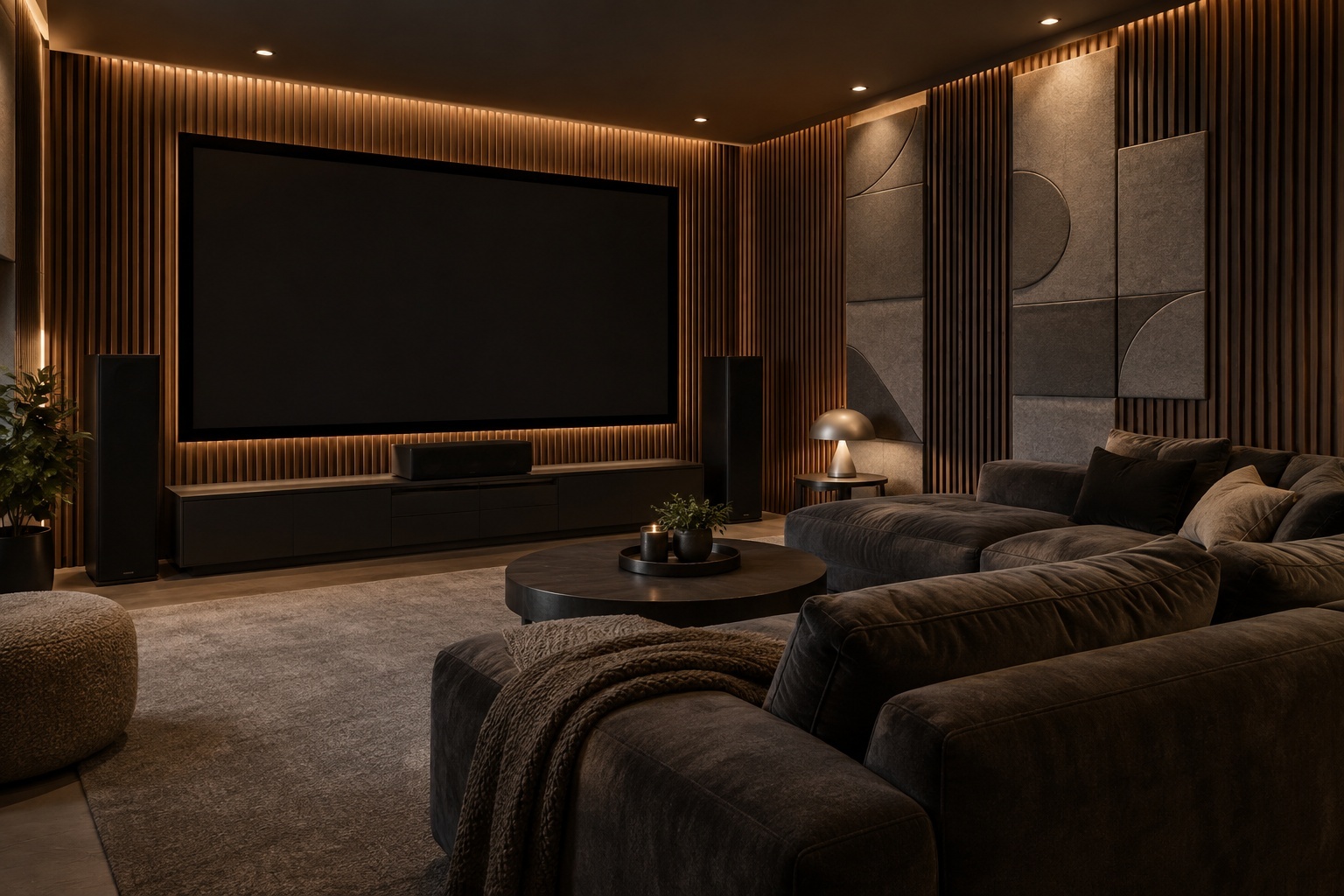
Two of the most popular acoustic finishes on the market look nothing alike and behave differently on the wall. Choosing between acoustic felt panels vs wood slat panels comes down to how much absorption the room actually needs, what look you’re after, and how much installation effort you’re willing to take on.
This guide compares the two on acoustics, aesthetics, ideal rooms, installation, and cost — so you can specify the right one the first time.
How Each One Absorbs Sound
Both products manage reverberation, but they get there by different routes. The shorthand is NRC — Noise Reduction Coefficient — a rating from 0 to 1 describing how much sound energy a surface absorbs rather than reflects. An NRC of 0.75 means roughly 75% of incident sound is absorbed.
Acoustic Felt Tiles
PET felt is a dense, porous material. Sound waves enter the fibre structure, get converted to a tiny amount of heat through friction, and don’t come back. Because absorption happens across the whole face of the panel, felt tiles deliver broad, consistent absorption — particularly strong in the mid and high frequencies where speech lives. That’s why felt is the default choice when the goal is intelligibility: meeting rooms, call areas, classrooms.
Thickness matters more than anything else. A 9 mm tile mounted flat gives useful but modest absorption; a thicker panel, or the same panel mounted with an air gap behind it, performs substantially better at lower frequencies.
Wood Slat Panels
Slat panels are a composite: timber or timber-look blades mounted over an acoustic felt backer, with gaps between the blades. Sound passes through the gaps, hits the felt, and is absorbed. The blades themselves also scatter sound, which diffuses reflections rather than eliminating them.
The practical consequence: for a given wall area, slat panels usually absorb somewhat less than a solid felt surface of similar thickness, because a portion of the face is solid wood. What they give back is diffusion, which keeps a room from sounding dead — valuable in spaces where you want warmth rather than silence.
The Honest Summary
Felt is the higher-absorption option per square metre. Slat panels trade some absorption for visual impact and a livelier acoustic. In most real projects the difference is bridged by coverage: you simply specify more slat wall area, or you combine the two.
Design and Aesthetic Differences
Felt tiles read as soft, contemporary, and colour-driven. They come in a wide colour range and geometric shapes — hexagons, squares, beveled and sculpted profiles — so the wall becomes a graphic feature. They suit branded environments, playful workplaces, and anywhere you want colour without paint. Felt is also matte and non-reflective, which quietly helps with glare in video-call spaces.
Slat panels read as warm, architectural, and premium. The repeating vertical rhythm makes ceilings feel taller and long walls feel intentional. In natural wood or wood-effect finishes they pair easily with stone, concrete, and greenery. Slats are the finish clients ask for by name after seeing a hotel lobby or a boutique fit-out.
There’s also a maintenance difference. Felt is easy to vacuum but can mark; wood blades wipe clean but the gaps collect dust and need occasional attention.
Best Rooms for Each
Choose Felt When…
- Meeting rooms and boardrooms — speech clarity is the whole job.
- Open-plan offices — broad absorption across a lot of surface area, and felt works on ceilings and dividers as well as walls. See our guide to open-plan office acoustics.
- Classrooms and training rooms — high absorption, impact-tolerant, available in bright colours.
- Home offices and studios — maximum reverb control in a small footprint.
- Ceilings and dividers — felt’s light weight makes overhead and free-standing applications simple.
Choose Slat Panels When…
- Reception areas and lobbies — a design-forward first impression that also softens a hard, echoey volume.
- Hospitality and retail — warmth and texture where a fully absorbent room would feel flat.
- Living rooms and media rooms — reverb control that looks like joinery, not treatment.
- Corridors and feature walls — the vertical rhythm handles long runs beautifully.
Or Use Both
The most effective specifications usually mix them: slat panels on the feature wall people see, felt on the ceiling and the walls they don’t. That combination hits the absorption target while keeping the design intent intact. Where you place either one matters as much as which you choose — our acoustic panel placement guide covers first-reflection points and coverage rules.
Installation Effort
Felt tiles are the easier install. They’re light, cut with a utility knife, and mount with adhesive, hook-and-loop, or simple mechanical fixings. Individual tiles can be repositioned during layout, and a DIY-capable person can do a feature wall in an afternoon. Getting a geometric pattern to line up neatly is the main skill required.
Slat panels come in larger sheets and are heavier. They need level battens or a flat substrate, accurate cutting around outlets and switches, and careful planning of the joint lines so the blade rhythm reads continuously across panels. It’s very achievable for a competent installer, but it’s a carpentry job rather than a stick-on job. Trims and end caps matter for a clean result.
On cost: felt tiles generally sit at the lower end per square metre with minimal installation labour, while slat panels cost more per square metre and carry higher install labour. When you compare total project cost, the gap is usually wider than the material price suggests.
The Imagine Acoustics Product Lines
- Wall Tiles — the core PET felt range, in a variety of shapes and colours. The workhorse for offices, classrooms, and home studios where absorption is the priority.
- Yugo blades — the slatted wood-look system: vertical blades on an acoustic backer, for feature walls, lobbies, and hospitality spaces.
- Duet — a layered felt system that adds depth and dimension to a wall, sitting visually between flat tiles and full slatted profiles.
- Transfer Series — sculpted felt profiles for spaces that need both meaningful absorption and a strong visual identity.
If you like the look of slats but need higher absorption, Duet and the Transfer Series are the middle ground worth looking at before defaulting to one or the other. Our earlier piece on acoustic slat wall panels goes deeper on the slat side specifically.
Frequently Asked Questions
Which absorbs more sound, felt or wood slats?
Per square metre, felt — because the whole face is absorptive, where slat panels have solid blades across part of theirs. Slat panels compensate with diffusion, and the gap closes when you increase coverage area.
Will either one soundproof my room?
No. Both control reverberation inside a room. Stopping sound travelling between rooms requires mass, decoupling, and sealing — a construction question, not a panel question.
How much wall coverage do I need?
As a rule of thumb, 15–25% of the room’s total surface area treated makes a clearly audible difference in a typical office or living space. Rooms with lots of glass and hard floors sit at the higher end.
Can I install slat panels myself?
If you’re comfortable with battens, a level, and accurate cuts, yes. If the wall is uneven or you have lots of outlets to work around, a professional install is money well spent.
Are PET felt panels environmentally friendly?
PET felt is typically made from recycled plastic bottles and is itself recyclable, which is a large part of why it’s become the standard material in commercial acoustic treatment.
Do they work on ceilings?
Felt tiles, yes — light and easy to fix overhead. Slat systems can be used on ceilings but need proper structural fixing given the weight.
Specify the Right Panel for Your Space
If your priority is quieting a room and making speech clear, start with felt. If it’s making a space look exceptional while taking the edge off the echo, start with slats. For most projects the right answer is a considered mix of both.
Browse the full panel range or request a quote and our team will help you size the coverage for your room.